
Industry 4.0 revolution is transforming the manufacturing ecosystem, and metal 3D printing is a crucial catalyst. This advanced additive manufacturing is revolutionising the way companies perform mass production. Whether automotive, aerospace, healthcare, or consumer products, metal printing is accelerating the manufacturing domain.
It is an ideal technology for mass manufacturing as it offers higher agility and flexibility to businesses. If you are new to this advancement and want to explore more, we’ve got you covered.
What is metal 3d printing?
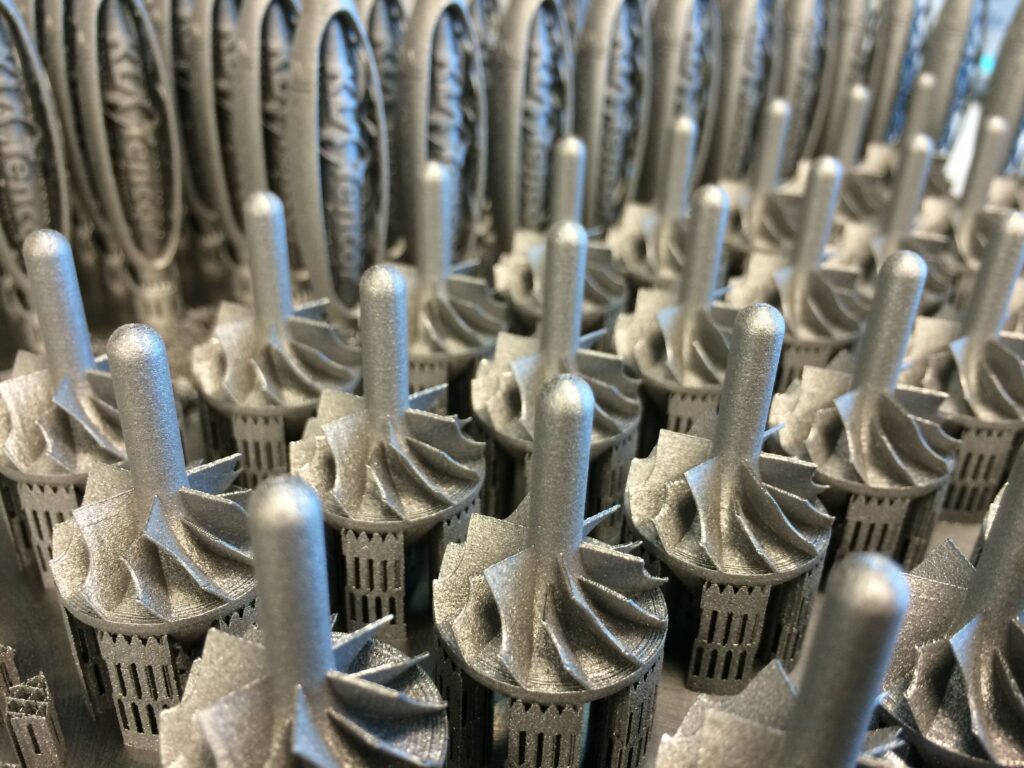
Image Source: Pinterest
Metal 3d printing is a robust manufacturing process that works on laser-based technology. In this process, the 3d printer uses powdered metals and a strong laser sinters the metal particles to produce a physical object.
After stacking, the powder bed is moved out, and a new layer of metal powder is spread over the previous one. The machine repeats this process until you get your desired product. The most popular metal 3d printing technologies that manufacturers across industries use are DMLS (Direct Metal Laser Sintering) and SLM (Selective laser melting).
Types of metal 3d printing for mass production
When it comes to mass production, several advanced printing technologies are available that deliver cutting-edge results. Below are some high throughput metal 3d printing methods used for mass production.
Single Pass Jetting
It is an advanced version of the traditional binder jetting printing in which the machine uses resin to fix powder in a layered manner. In this process, the printing head holds two powder spreaders along with a spray unit. In this process, the machine deposits a 50-micron metal powder, compacted into a thin layer. The layer then solidifies through 16,000 microjet nozzles that deposit binder resin droplets on the powder layer. The resin-contacted part turns solid, whereas the rest of the powder remains untouched that is possible to use again.
Anti-Sintering Layers
It is another popular mass production method that offers higher flexibility to manufacturers. In the anti-sintering layers method, the 3d printer sprays an anti-sintering agent between the workpiece & the support. It makes it easier for engineers to remove the support quickly without using any tool.
On the contrary, conventional additive manufacturing uses a series of support structures to hold the object. This support becomes challenging to remove once the component is ready. Thus, this modern process saves both time and money.
Stackable Builds
It is among the newest metal print advancements in which the complete build volume is filled with parts and separated from one another using powder layers. In this process, the 3d printer can manufacture multiple objects simultaneously, saving both time and resources. It is an ideal mass manufacturing technology as it can produce several components simultaneously without compromising the quality. The stackable builds method is helpful in mass manufacturing as it saves 3d printing materials and time.
How does metal 3d printing work?
Most metal 3d printers work on laser-based technology to print metals. It uses powdered material and an intense laser beam that melts the powder particles together, layer after layer, to produce a physical object. The printer keeps adding layers of powders as per your product design until it gets the proper structure.
There are two types of technologies — powder bed and laser metal deposition. In powder bed methods, the 3d printer uses a printing bed on which the powder metal is fused to create the desired shape. On the contrary, the metal deposition methods function by adding material layers until the design is completed.
Metal 3D Printing services benefits for mass production
There are several state-of-the-art benefits of leveraging metal additive manufacturing techniques that give a competitive edge to businesses.
Faster turnaround time
Metal 3d printing gives a 50%-80% shorter lead time to manufacturers. It saves the manufacturing cost, and hence many industries prefer it. For instance, with metal 3d printers, you can deliver a product in a few hours compared to conventional methods that take multiple weeks. Thus, its ideal for companies to perform mass manufacturing and deliver products to market faster.
Optimised design
Due to the increased possibilities of computer-aided design (CAD) software, designing has become easier than ever before. CAD tools support metal printing processes and help achieve optimised designs by minimising material usage and reducing production costs. In metal 3d printing, the objects are produced with extreme precision, due to which designers have complete control over each of their designs, from its shape and structure to its geometry. In addition, it ensures a highly-optimised design with better surface finishes as compared to conventional manufacturing techniques.
Cost-effective
One of the most significant benefits is that metal 3d printing in mass manufacturing is cost-effective and has a great ROI. Companies can produce intricate geometrical structures that are impossible through machining or welding, saving your money on time and material wastage. It also reduces your production time, increasing efficiency and productivity by manifolds.
Wrapping up!
Metal 3d printing is the future of mass manufacturing that will help companies gain a competitive edge in the industry. Get ahead of the curve by integrating metal additive manufacturing and cost-effectively delivering high-quality products. With growing Industry 4.0 applications, metal 3d manufacturing will give accelerated growth to companies.